> ## Documentation Index
> Fetch the complete documentation index at: https://docs.privy.io/llms.txt
> Use this file to discover all available pages before exploring further.
# Overview
> Put wallet balances to work with yield from tokenized money market funds and DeFi vaults.
Earn enables apps to generate yield on wallet balances. Deposit into vaults, withdraw at any time, and track positions in real time, all with a few API calls. Privy simplifies vault deployment, smart contract interactions, and onchain execution.
 ## Capabilities
* **Deposit and withdraw** assets into yield vaults with a single API call per operation
* **Query positions** to display real-time holdings, accrued yield, and vault shares
* **Collect fees** from a configurable share of the yield generated through your app
* **Sponsor gas** for your users — if your app has [gas sponsorship](/wallets/actions/overview#gas-management) enabled, Privy automatically sponsors gas for earn deposit, withdraw, and incentive claim actions
## Supported yield providers
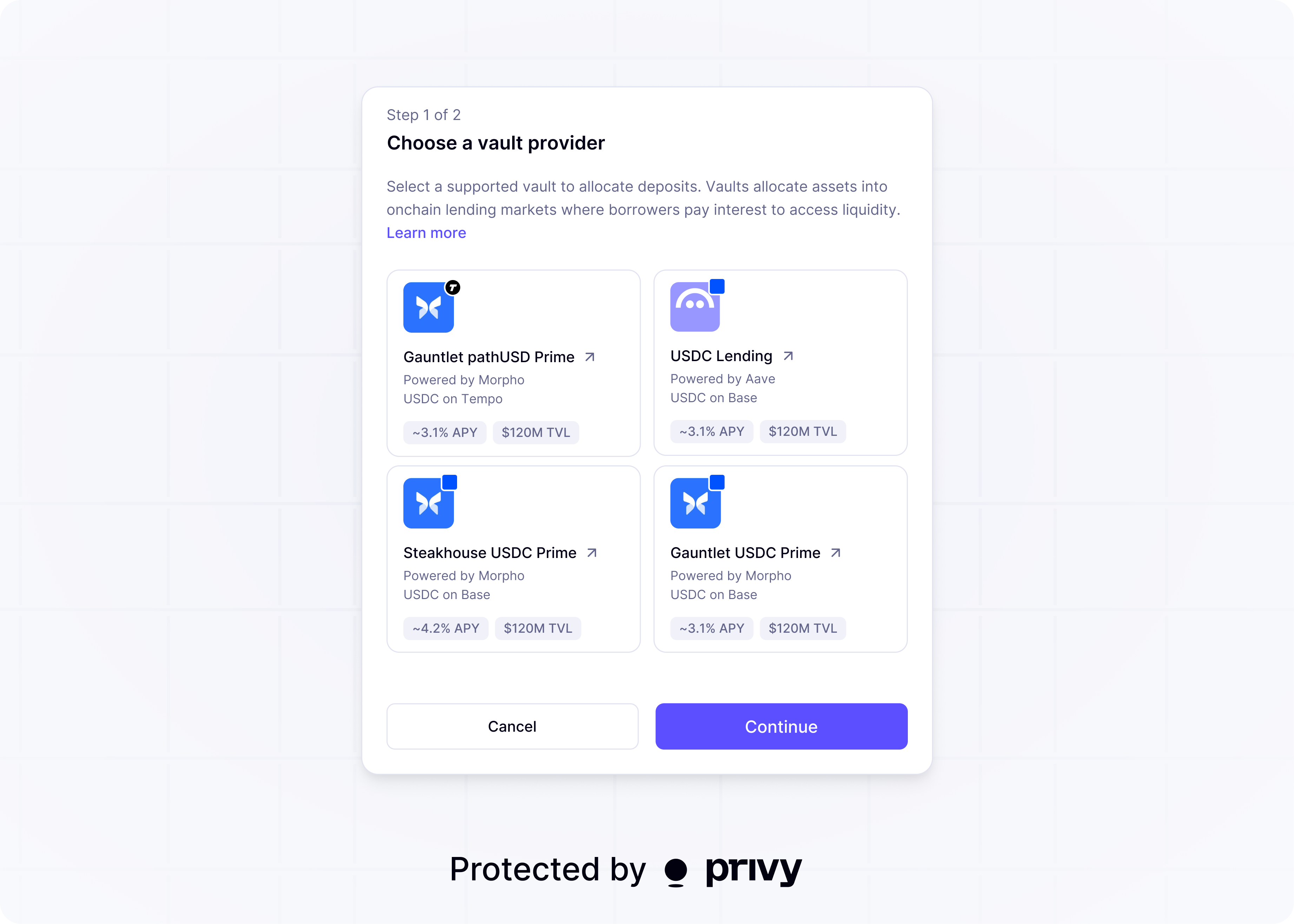
Earn supports multiple providers through a single API. Your app deposits, withdraws, and reads positions through the same endpoints, regardless of provider.
Yield is generated via tokenized money market funds, other real world assets, and DeFi lending. A select set of yield sources are available in the Privy Dashboard for self-serve setup. Contact [sales@privy.io](mailto:sales@privy.io) to enable additional Veda, Aave, Morpho, and Kamino vaults from any curator, on any chain.
Your app should make clear to end users that yield is generated via a tokenized money market fund,
real world asset, or DeFi protocol independent from the wallet provider. Users keep full control
of their assets and should explicitly direct the deposit action.
## Tokenized money market funds
Tokenized money market funds (TMMFs) invest in short-term, high-quality debt such as US Treasury bills and repurchase agreements. The fund earns interest on these holdings, and that interest is the source of the yield. Rates track prevailing short-term benchmarks rather than onchain borrower demand.
Yield reaches token holders in one of two ways, depending on the fund:
* **Accruing tokens** rise in value as interest accrues; each redeems for more of the underlying asset over time.
* **Distributing tokens** hold a stable value and pay yield as additional tokens on a recurring schedule.
Contact [sales@privy.io](mailto:sales@privy.io) to enable tokenized money market fund yield for your app.
## DeFi yield
DeFi vaults allocate deposited assets into onchain lending markets where borrowers pay interest to access liquidity. That interest flows back to the vault, increasing the value of deposited shares over time. Vault strategies are managed by curators who determine how capital is allocated across markets to balance risk and return.
APY fluctuates based on borrower demand, market utilization, and the curator's allocation strategy. Some vaults also distribute additional token incentives on top of the base lending yield. All lending and borrowing happens onchain through non-custodial smart contracts.
### How DeFi yield accrues
ERC-4626 vaults track balances in **shares**. A deposit converts assets into shares at the current share price. As interest accrues, the share price rises — each share redeems for more of the underlying asset. Yield accrues passively with no claiming or compounding required, and withdrawals return the original deposit plus earned yield.
Example: a wallet deposits 1,000 USDC at a share price of 1.00 and receives 1,000 shares. When the share price reaches 1.05, those shares are worth 1,050 USDC. No new shares are minted; existing shares appreciate.
Vault shares are standard ERC-20 tokens and can be transferred between wallets like any other token.
## Revenue sharing
Your app can earn revenue by capturing a configurable share of the yield generated by its users' deposits. An admin wallet your app controls receives the fees. How your app configures and collects the fee depends on the vault provider:
* **Morpho vaults** use a fee wrapper that captures up to 50% of accrued yield as shares in the admin wallet. Your app can withdraw those shares at any time to collect fees.
* **Aave vaults** let your app apply a performance fee of up to 100% of yield, of which Aave Labs takes 50%. Fees accumulate in the vault until your app collects them. See [collect performance fees](/wallets/actions/earn/providers/aave#collect-performance-fees).
* **Veda vaults** accrue performance fees that Veda claims and withdraws to your admin wallet on a recurring schedule — typically weekly or monthly, per your agreement with Veda.
## Next steps
Deploy a fee wrapper and configure your vault in the Privy Dashboard.
A working Next.js app with end-to-end deposit and withdraw flows.
Privy does not control DeFi vaults or underlying protocols. Vault information is provided for
reference only and may change or be inaccurate. Earnings are generated from third-party vaults and
are not guaranteed. Using vaults involves risk, including loss of funds. These materials are for
general information purposes only and are not investment advice or a recommendation or
solicitation to engage in any specific transaction. You are responsible for evaluating vaults at
your own discretion. Privy does not provide investment, financial, legal, or tax advice.
## Capabilities
* **Deposit and withdraw** assets into yield vaults with a single API call per operation
* **Query positions** to display real-time holdings, accrued yield, and vault shares
* **Collect fees** from a configurable share of the yield generated through your app
* **Sponsor gas** for your users — if your app has [gas sponsorship](/wallets/actions/overview#gas-management) enabled, Privy automatically sponsors gas for earn deposit, withdraw, and incentive claim actions
## Supported yield providers
Earn supports multiple providers through a single API. Your app deposits, withdraws, and reads positions through the same endpoints, regardless of provider.
Yield is generated via tokenized money market funds, other real world assets, and DeFi lending. A select set of yield sources are available in the Privy Dashboard for self-serve setup. Contact [sales@privy.io](mailto:sales@privy.io) to enable additional Veda, Aave, Morpho, and Kamino vaults from any curator, on any chain.
Your app should make clear to end users that yield is generated via a tokenized money market fund,
real world asset, or DeFi protocol independent from the wallet provider. Users keep full control
of their assets and should explicitly direct the deposit action.
## Tokenized money market funds
Tokenized money market funds (TMMFs) invest in short-term, high-quality debt such as US Treasury bills and repurchase agreements. The fund earns interest on these holdings, and that interest is the source of the yield. Rates track prevailing short-term benchmarks rather than onchain borrower demand.
Yield reaches token holders in one of two ways, depending on the fund:
* **Accruing tokens** rise in value as interest accrues; each redeems for more of the underlying asset over time.
* **Distributing tokens** hold a stable value and pay yield as additional tokens on a recurring schedule.
Contact [sales@privy.io](mailto:sales@privy.io) to enable tokenized money market fund yield for your app.
## DeFi yield
DeFi vaults allocate deposited assets into onchain lending markets where borrowers pay interest to access liquidity. That interest flows back to the vault, increasing the value of deposited shares over time. Vault strategies are managed by curators who determine how capital is allocated across markets to balance risk and return.
APY fluctuates based on borrower demand, market utilization, and the curator's allocation strategy. Some vaults also distribute additional token incentives on top of the base lending yield. All lending and borrowing happens onchain through non-custodial smart contracts.
### How DeFi yield accrues
ERC-4626 vaults track balances in **shares**. A deposit converts assets into shares at the current share price. As interest accrues, the share price rises — each share redeems for more of the underlying asset. Yield accrues passively with no claiming or compounding required, and withdrawals return the original deposit plus earned yield.
Example: a wallet deposits 1,000 USDC at a share price of 1.00 and receives 1,000 shares. When the share price reaches 1.05, those shares are worth 1,050 USDC. No new shares are minted; existing shares appreciate.
Vault shares are standard ERC-20 tokens and can be transferred between wallets like any other token.
## Revenue sharing
Your app can earn revenue by capturing a configurable share of the yield generated by its users' deposits. An admin wallet your app controls receives the fees. How your app configures and collects the fee depends on the vault provider:
* **Morpho vaults** use a fee wrapper that captures up to 50% of accrued yield as shares in the admin wallet. Your app can withdraw those shares at any time to collect fees.
* **Aave vaults** let your app apply a performance fee of up to 100% of yield, of which Aave Labs takes 50%. Fees accumulate in the vault until your app collects them. See [collect performance fees](/wallets/actions/earn/providers/aave#collect-performance-fees).
* **Veda vaults** accrue performance fees that Veda claims and withdraws to your admin wallet on a recurring schedule — typically weekly or monthly, per your agreement with Veda.
## Next steps
Deploy a fee wrapper and configure your vault in the Privy Dashboard.
A working Next.js app with end-to-end deposit and withdraw flows.
Privy does not control DeFi vaults or underlying protocols. Vault information is provided for
reference only and may change or be inaccurate. Earnings are generated from third-party vaults and
are not guaranteed. Using vaults involves risk, including loss of funds. These materials are for
general information purposes only and are not investment advice or a recommendation or
solicitation to engage in any specific transaction. You are responsible for evaluating vaults at
your own discretion. Privy does not provide investment, financial, legal, or tax advice.